
Record label software built for independent labels.
Demos, contracts, releases, catalog and royalty statements read by AI: LabelBase is the record label software and CRM that runs your whole independent label in one place, instead of ten tools.
100+ releases managed monthly
Trusted by independent labels and modern music teams









Your label runs on ten tools that don't talk to each other.
Most independent labels run on a stack of free tools: a Discord server for demos, a Notion board for releases, a spreadsheet for splits, DocuSign for contracts and another spreadsheet for statements. It works until two people edit the same file, an artist sends masters to the wrong address, or a quarter's royalties have to be worked out by hand from five distributor reports. Record label software exists to end that: one workspace for demos, signings, releases, catalog and royalties.
- Discord
- Notion
- Google Sheets
- Gmail
- Adobe Acrobat
- Dropbox
- WeTransfer
- Airtable
In LabelBase, every demo, artist, contract, release, track and statement lives in the same place and knows about the others: the splits you set on a release are the ones that pay its royalties.
Record label CRM and A&R software
A label's CRM is its relationships: the artists who send demos, the ones you sign, and everyone you work with around them. LabelBase gives your A&R team one inbox for every submission and one network for every contact.
One inbox for every demo
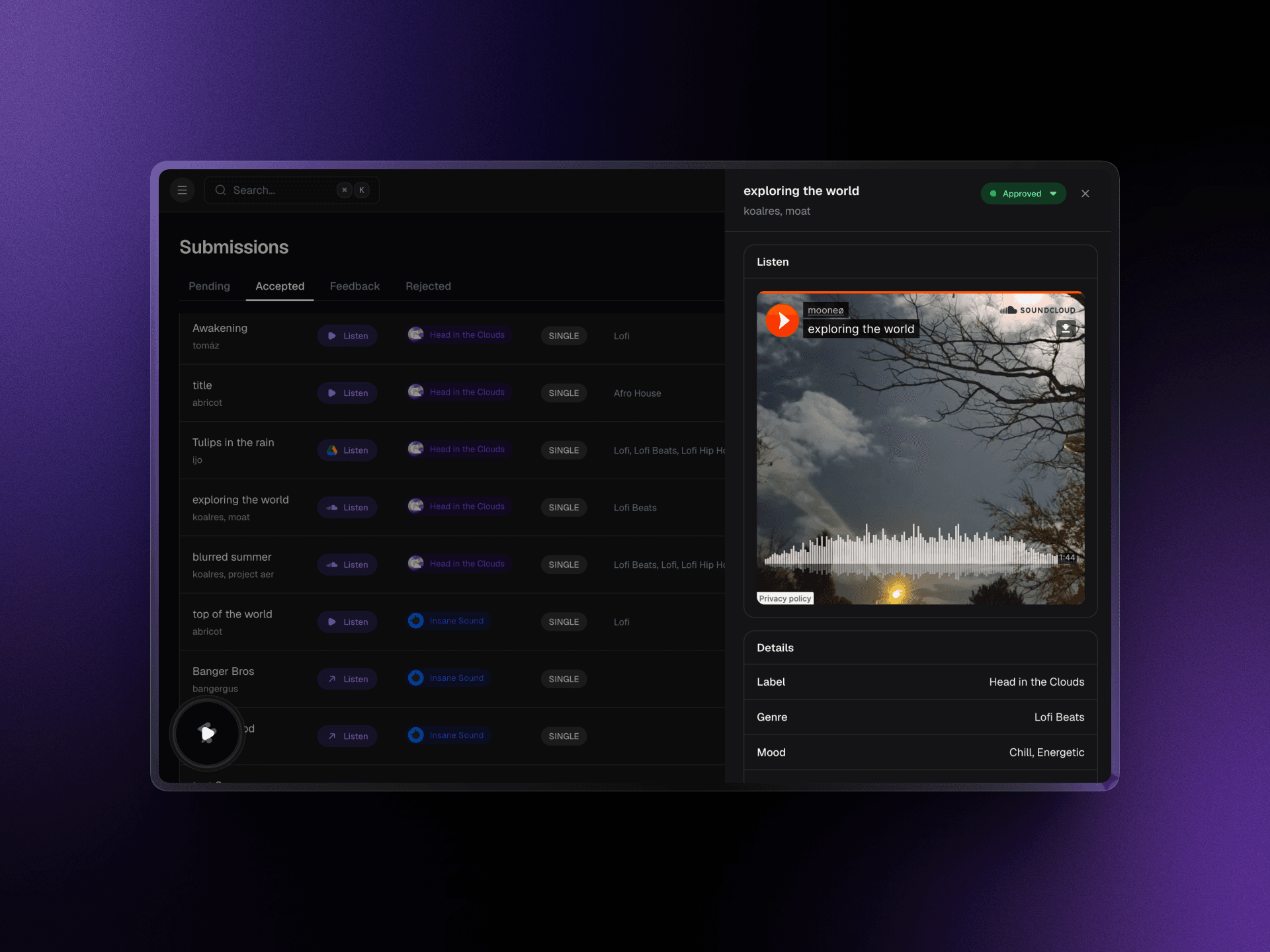
Demos sent through your website form, by email or on Discord all land in the same submissions inbox. AI formats the incoming data (titles, artists, genres, links) so every submission looks the same, wherever it came from.
Listen, rate and shortlist as a team
Stream tracks in the browser, leave notes and ratings, and move each demo to Pending, Accepted, Feedback or Rejected. The whole A&R team sees the same status, so no demo gets answered twice or forgotten.
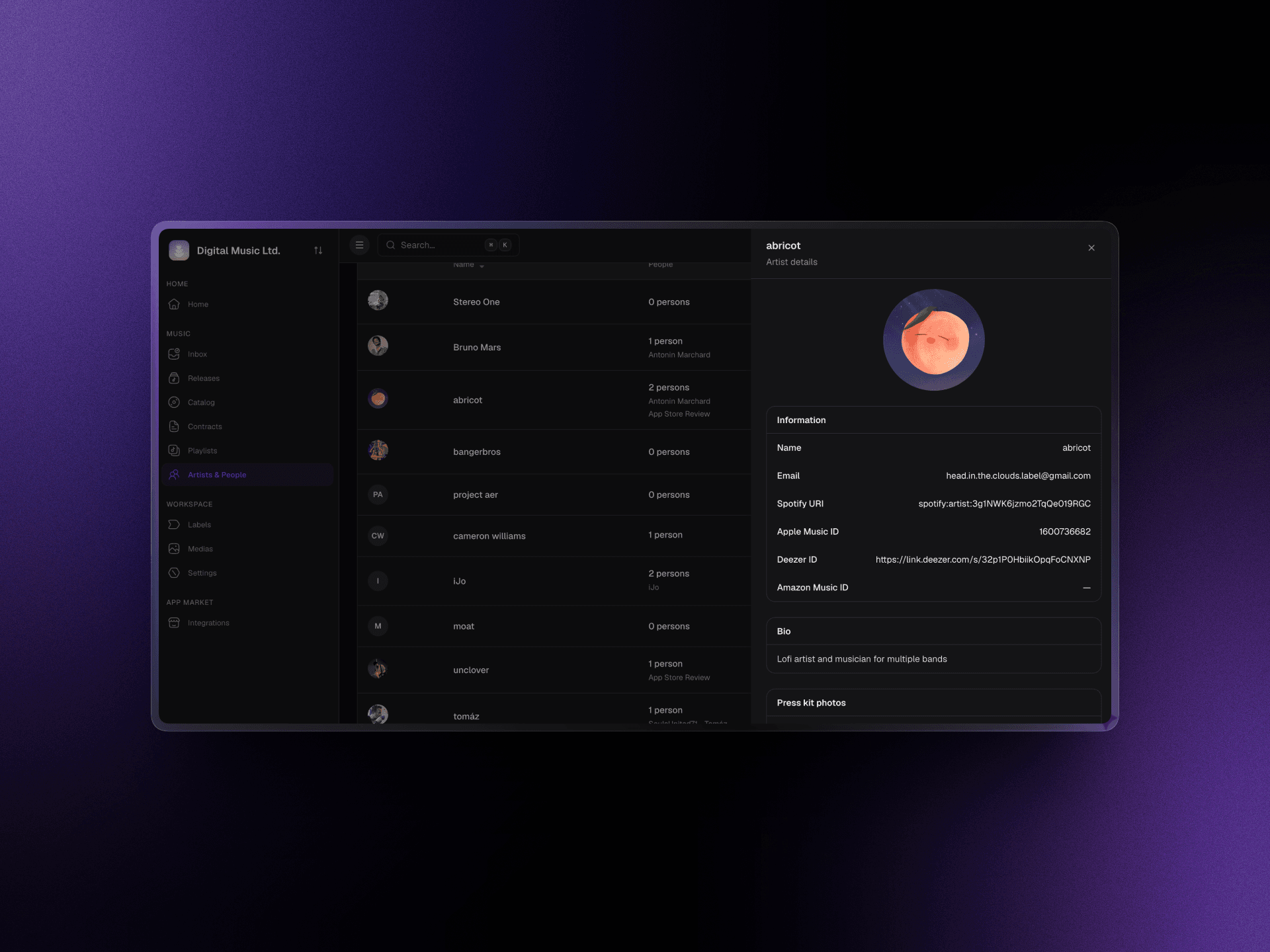
A network of artists and industry contacts
Keep your roster, your team and your industry contacts in one network, tagged by role, label, region or relationship. A shared artist database pre-fills artist information across LabelBase, while the link between an artist and your label stays private to your workspace.
Contracts and e-signatures for record labels
Once you've found the artist, the deal has to be signed. LabelBase generates the contract from your own templates and collects every signature without leaving the platform.
Templates with dynamic variables
Write your licensing, distribution or split agreements once, with placeholders for any field in LabelBase. Each contract comes out pre-filled with the release, the artist and the splits: no copy-paste, no wrong percentage.
Signing order and real-time tracking
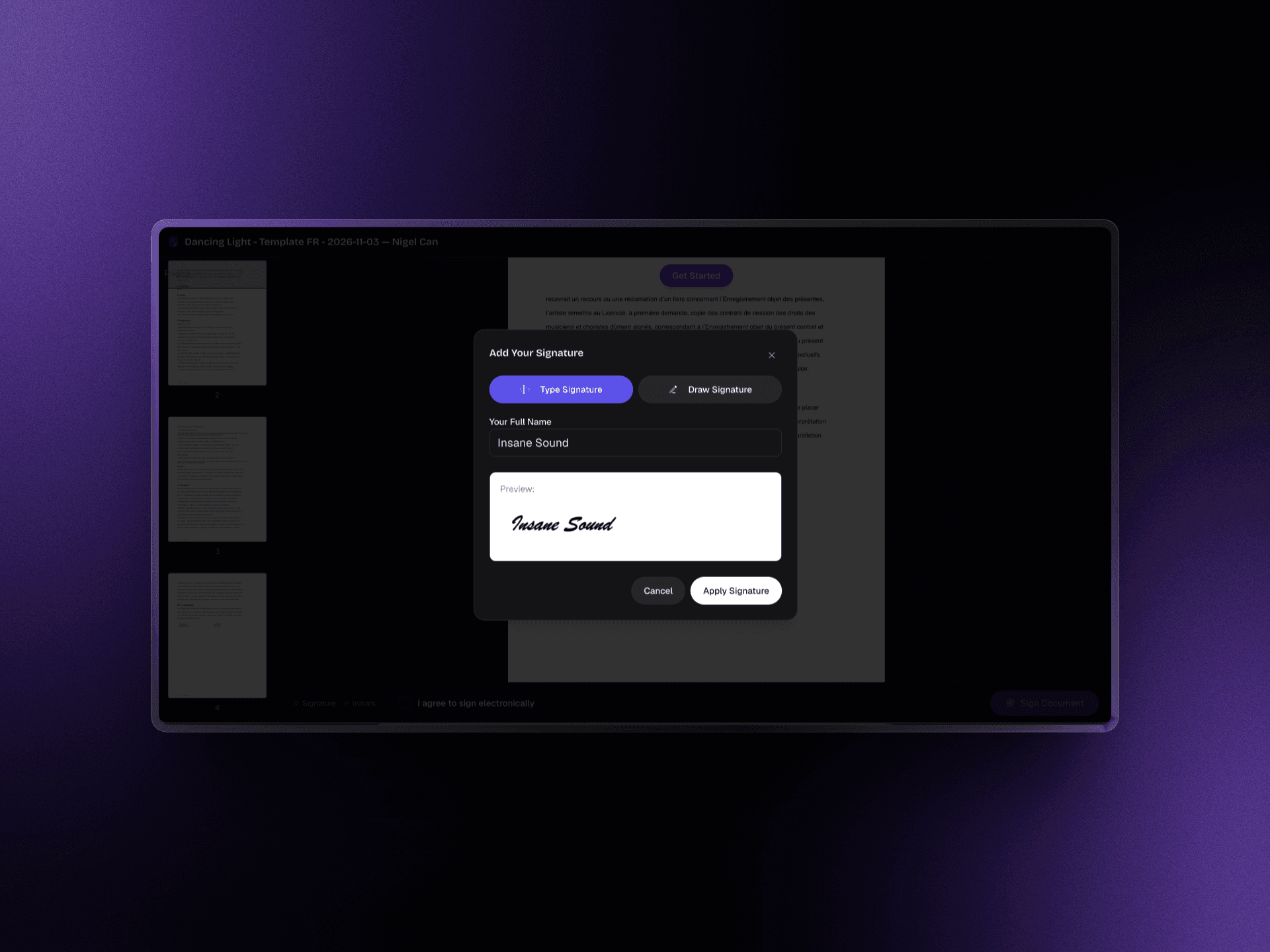
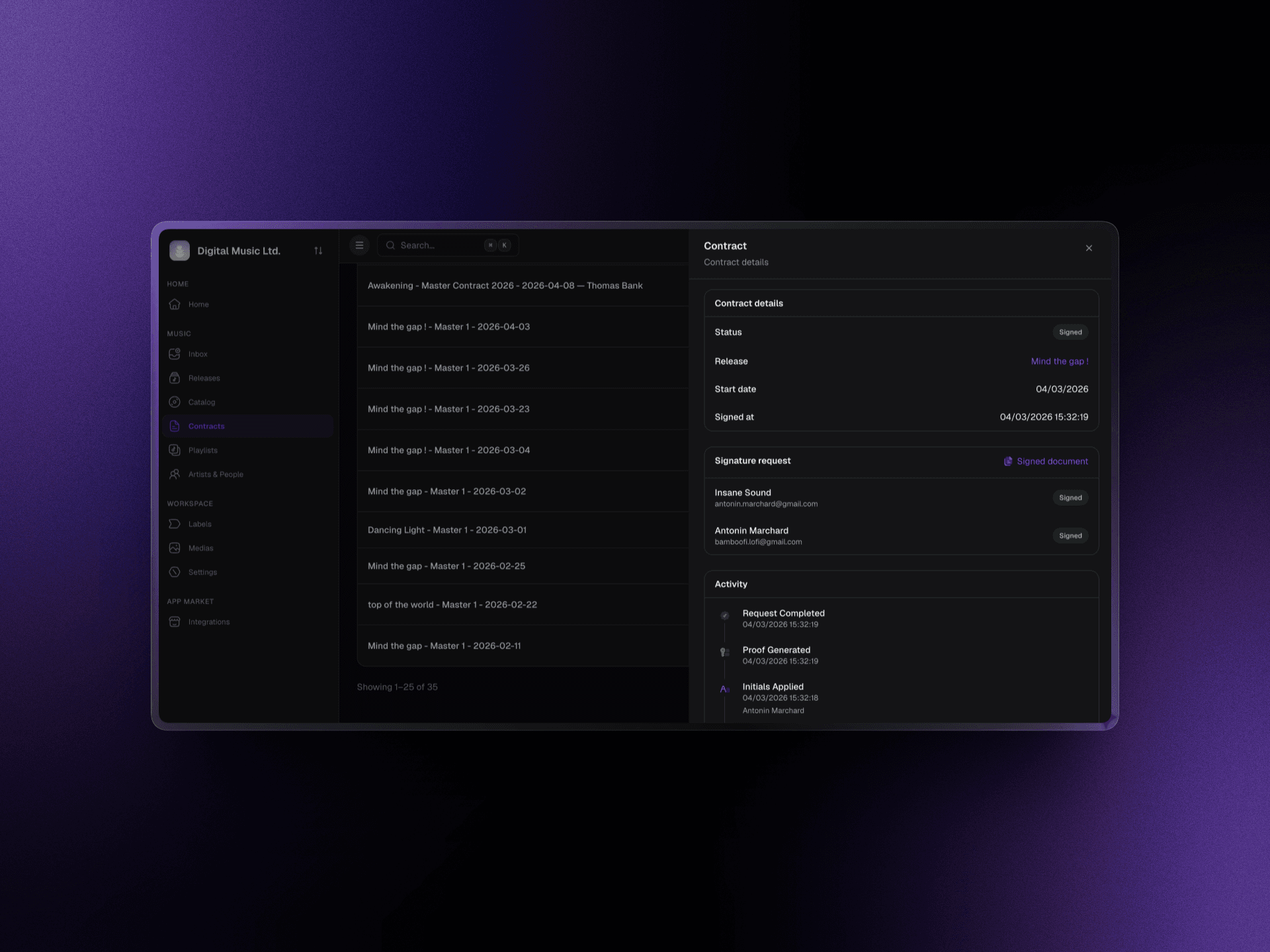
Choose the signers and the order they sign in. See whether each request is sent, viewed, signed or declined, and nudge a signer in one click instead of chasing them by email.
Legally binding, with a full audit trail
Signatures are eIDAS-compliant, timestamped under RFC 3161 and recorded step by step in an audit trail. The signed document and its proof stay attached to the release they belong to.
A release pipeline from master to release day
A signed track becomes a release, and a release is dozens of small jobs that all have to happen on time. LabelBase keeps them on the release itself.
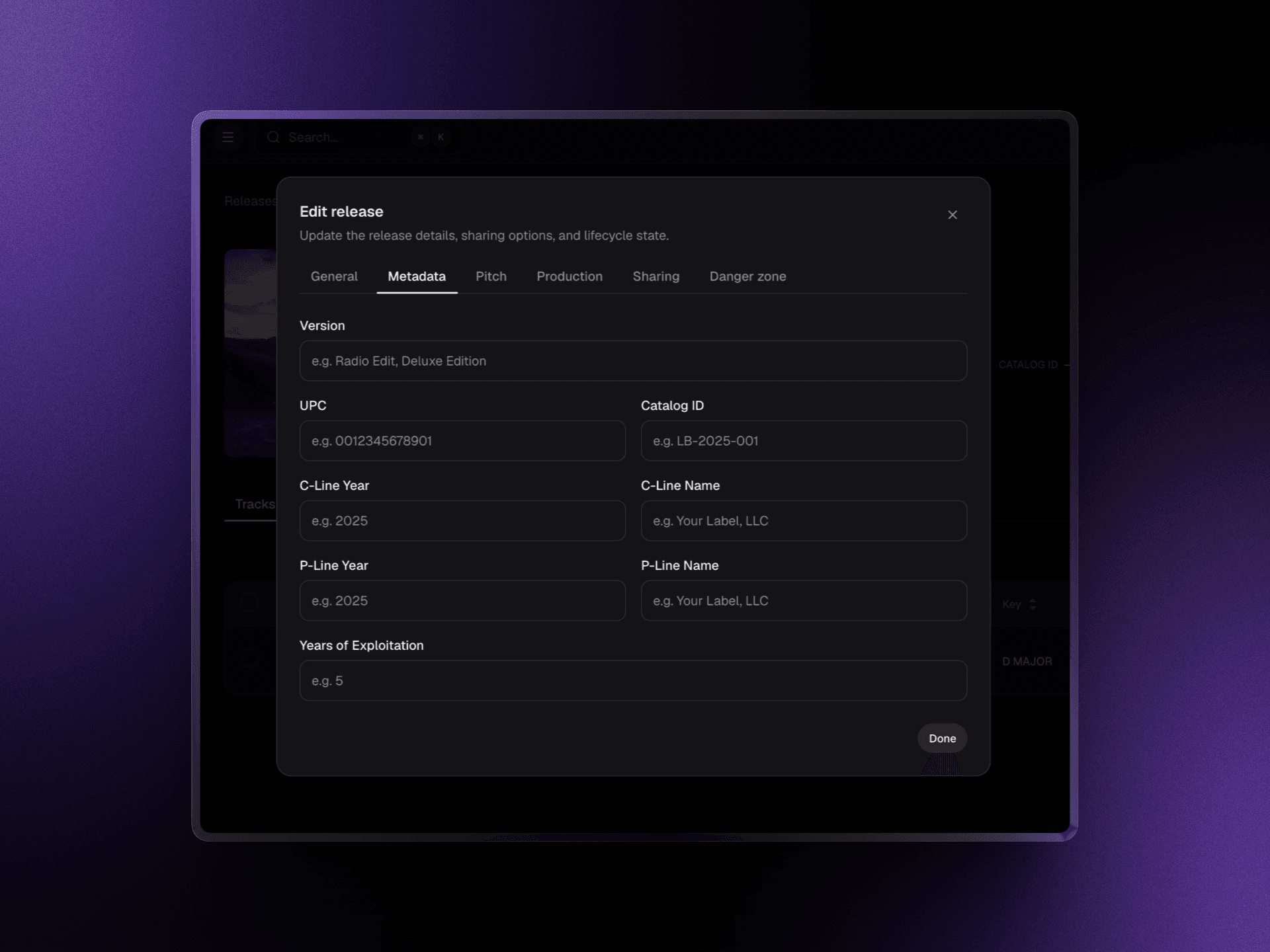
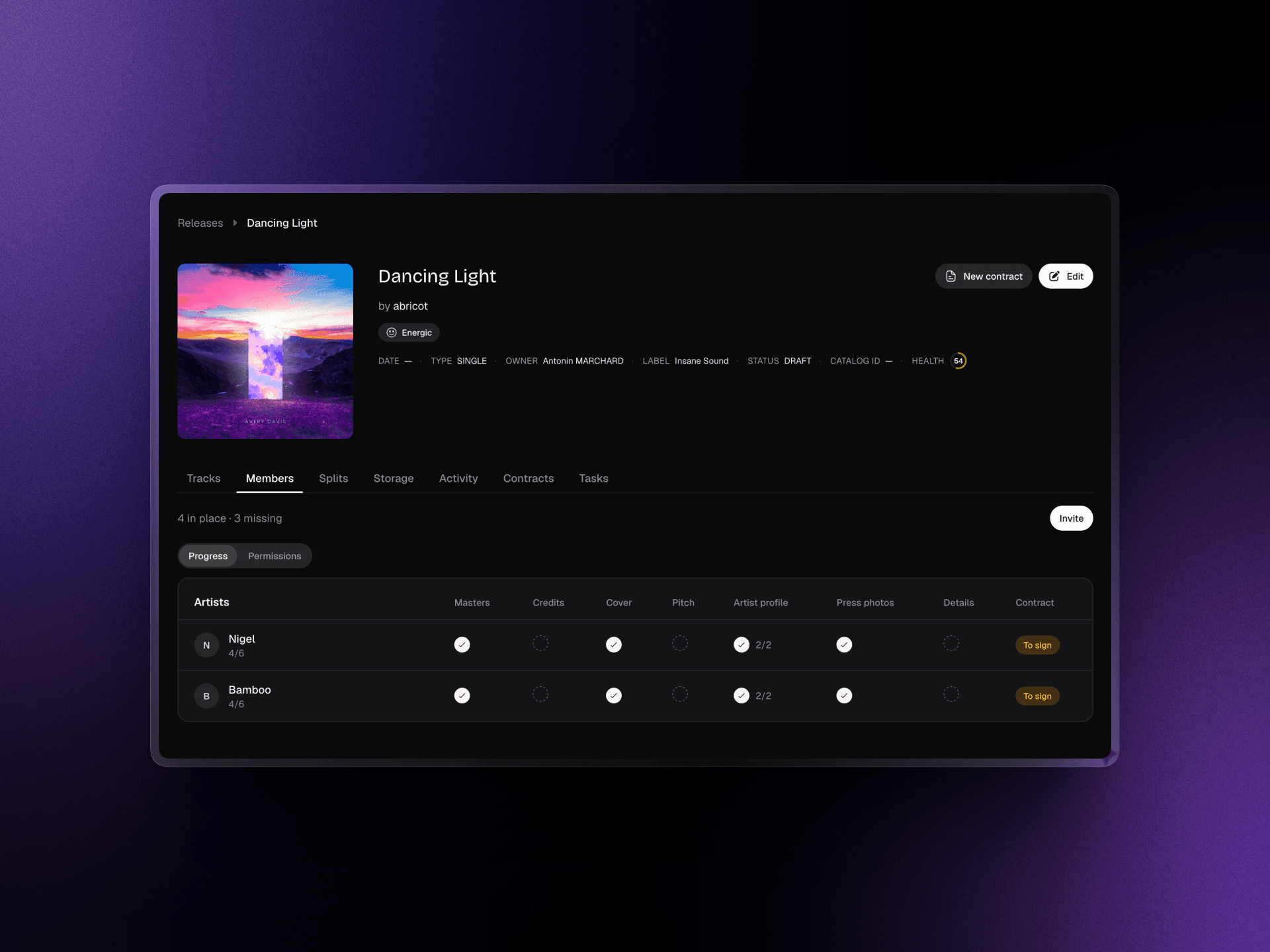
Everything about a release on one page
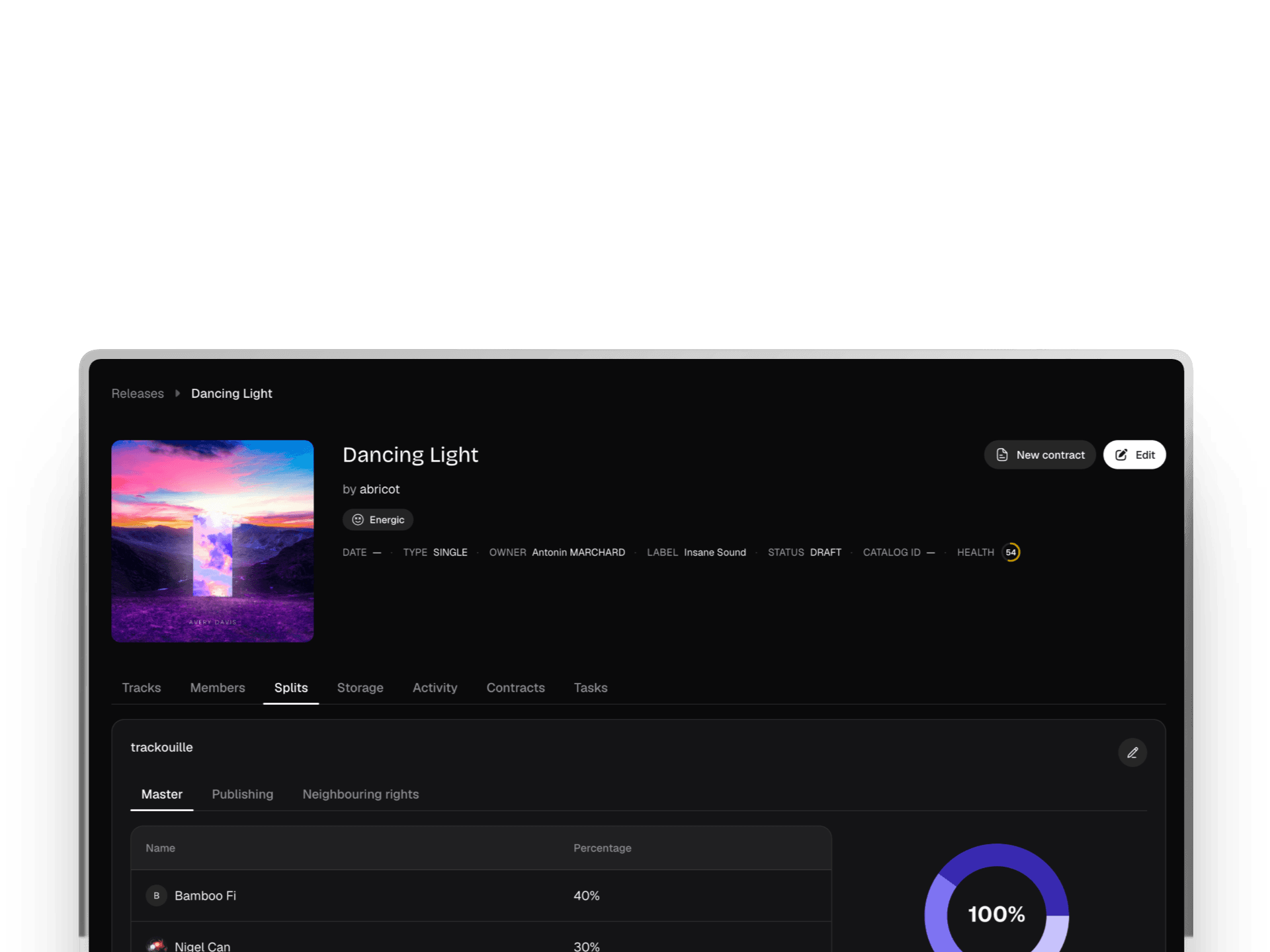
Tracks with their format, genre, BPM and key, team members, storage, activity, contracts and tasks: each release has its own page, so nobody has to ask where the latest master is.
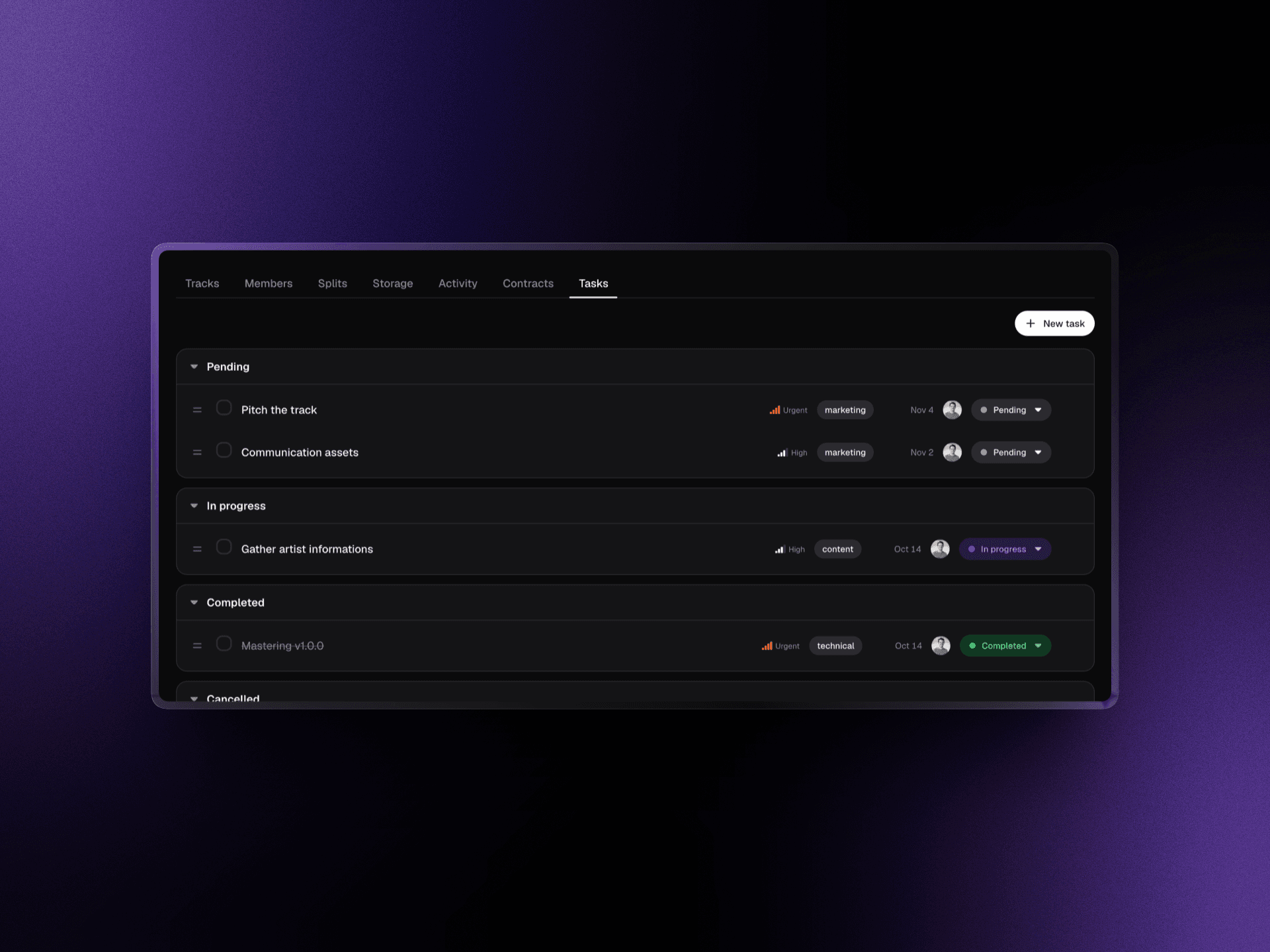
Tasks, owners and deadlines
Break each release into tasks, give each one an owner and a due date, and see what's pending, in progress or done. Version tracking keeps every mix and master, and compilations are managed like any other release.
Splits set once, used everywhere
Set the master, publishing and neighbouring rights splits on each track. They feed your contracts and, later, the royalty computation, so the split sheet is no longer a separate spreadsheet.
One link to collect assets from artists
Send an upload link and let the artist drop tracks and masters, cover art, the pitch text and their information. Everything lands attached to the right release.
A catalog and metadata enriched by AI
Every release you ship adds to your catalog. LabelBase keeps it structured and searchable, so it keeps working for you long after release day.
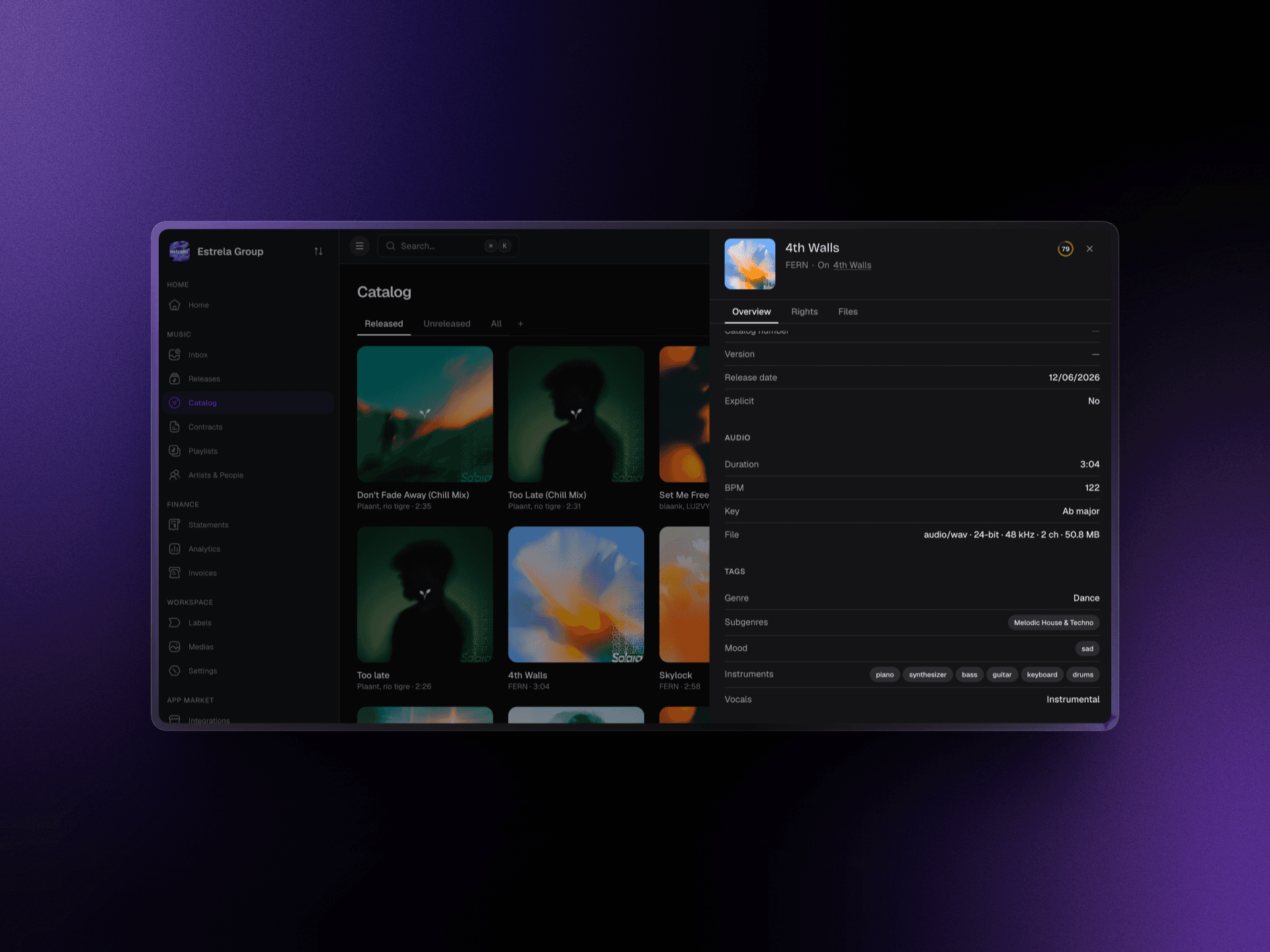
Metadata filled in by AI
LabelBase's AI listens to each track and fills in genre, mood, BPM, key and instrumentation as soon as the file lands. It is a real audio model running on private, self-hosted infrastructure, not a wrapper around a third-party LLM.
Deep filters
Combine genre, mood, BPM, key, tags and rights to find the right track for an editorial pitch, a sync brief or an internal A&R review in seconds.
Playlists to pitch
Drag tracks into a playlist as you browse, then share it as a public page with music supervisors, partners or curators. They don't need an account to listen.
Royalty statements, read by AI
This is where most label software stops, and where LabelBase keeps going. At the end of each period, it reads your distributors' statements and computes what each artist is owed from the splits already in your catalog.
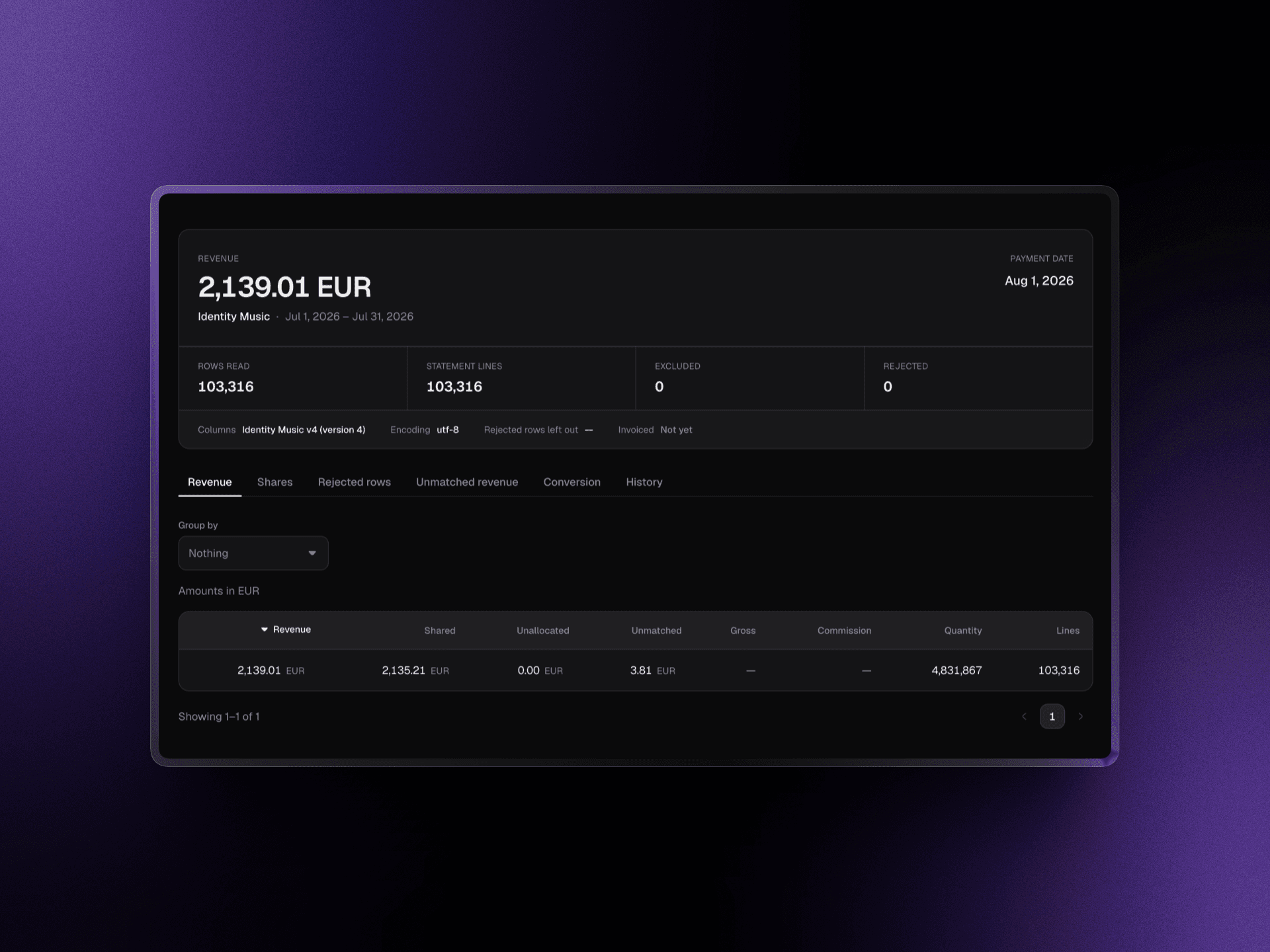
Import any distributor's statement
Believe, DistroKid, The Orchard, Identity, a sub-label's spreadsheet or your own CSV: drop the sales report and the AI recognizes its columns, encoding and reporting period, then matches every line to a track in your catalog. There is no template to follow and nothing to reformat by hand.
Shares computed from your catalog splits
The splits set on each track are the source of truth. Every statement line is matched to its track and each artist's share is computed automatically, with no side spreadsheet to keep in sync with your contracts.
Accurate to the cent, in any currency
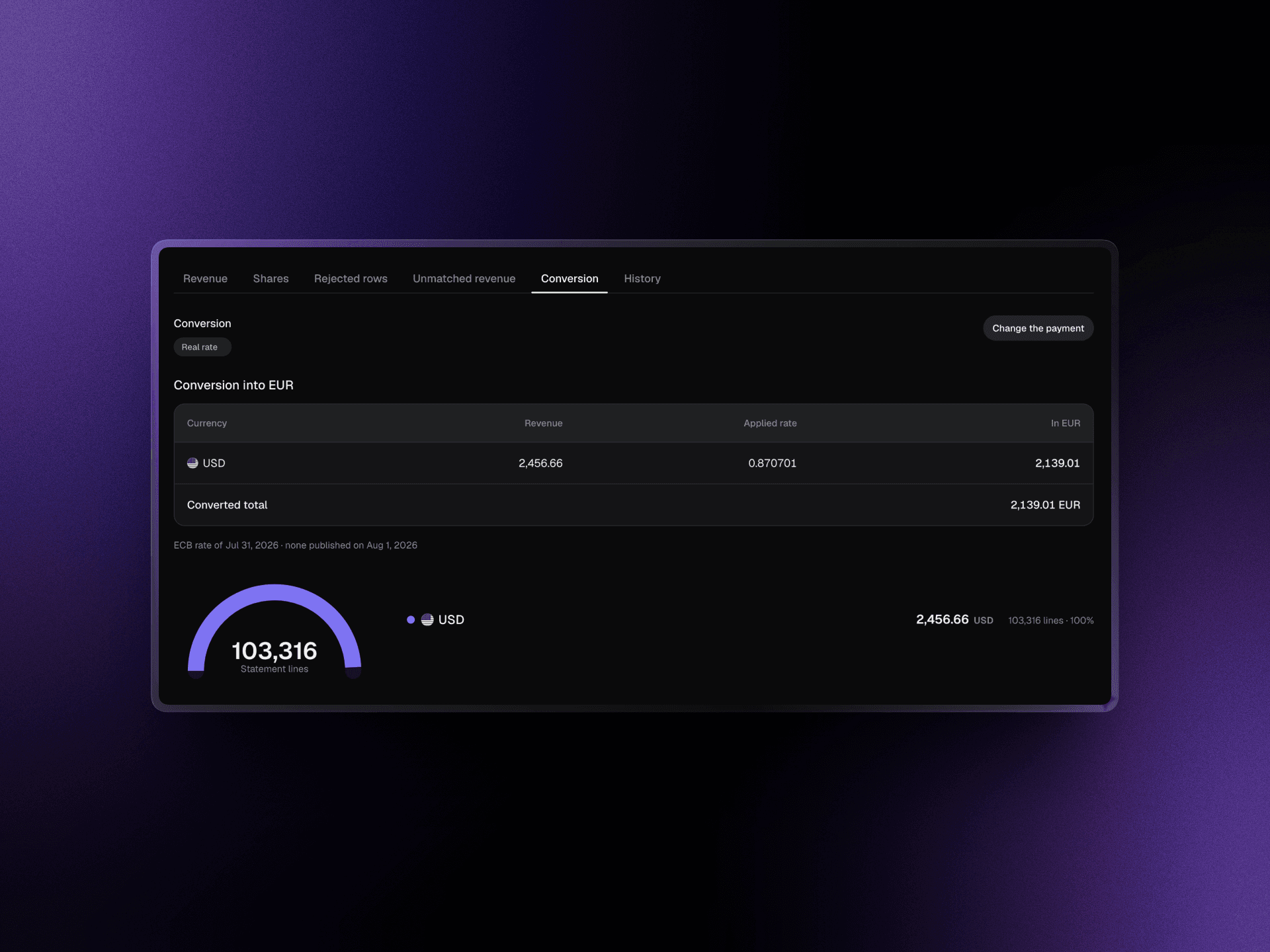
Statements paid in USD, AUD, BRL or any other currency are converted into your payment currency at the rate you were actually paid, and the rate applied is shown for each currency. Every row read is a statement line, excluded, or rejected with a reason, so totals always reconcile.
A royalty dashboard for the whole label
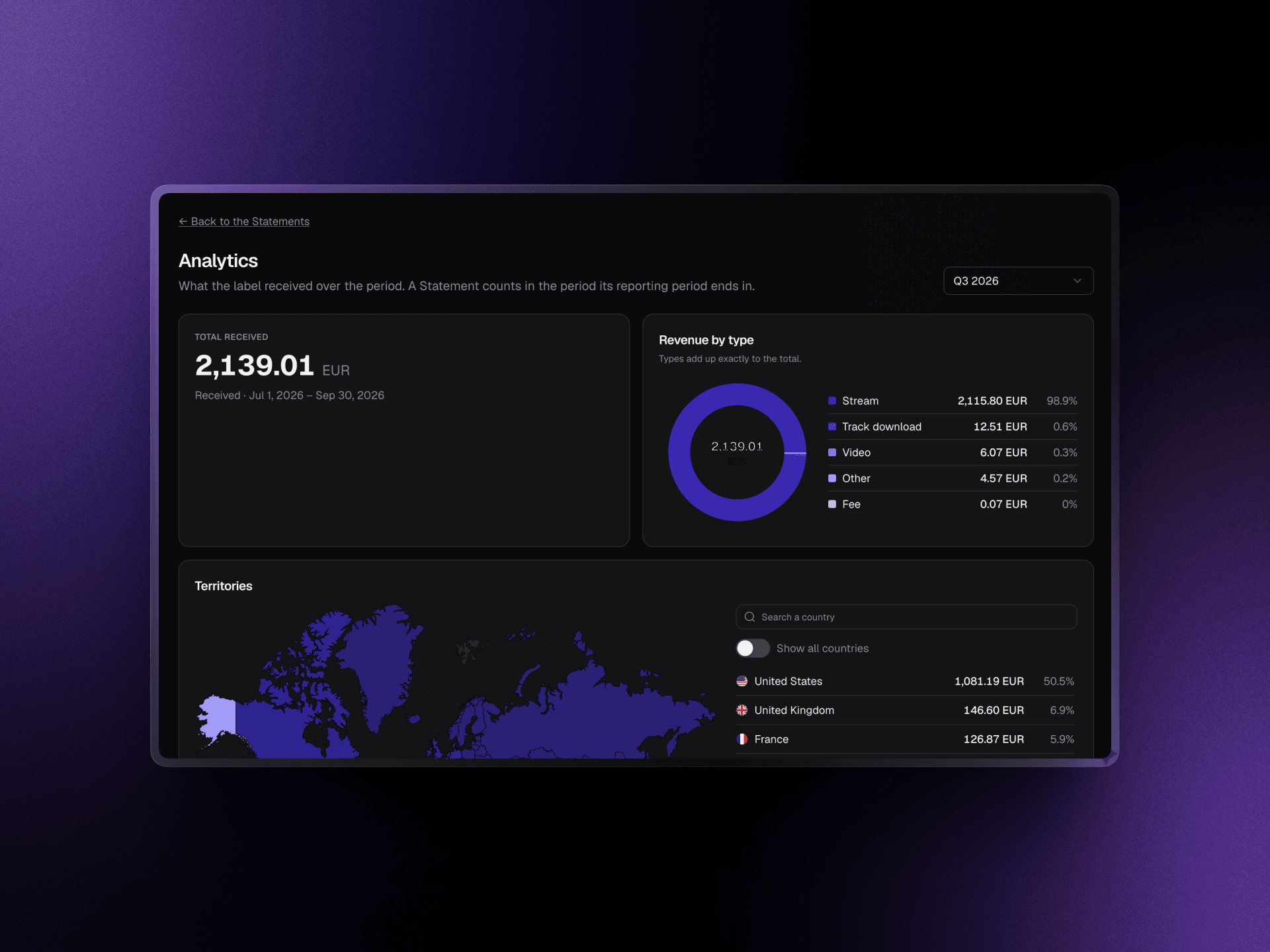
See the total received per period, revenue by type (stream, download, video) and revenue by territory down to the country. Statements can be reimported or withdrawn at any time, and their full history stays on record.
Release intake: one link per artist
Every artist, producer and manager on a release gets their own intake link, asking only for what their role should send. No account, no email threads.
Masters, artwork, credits and details
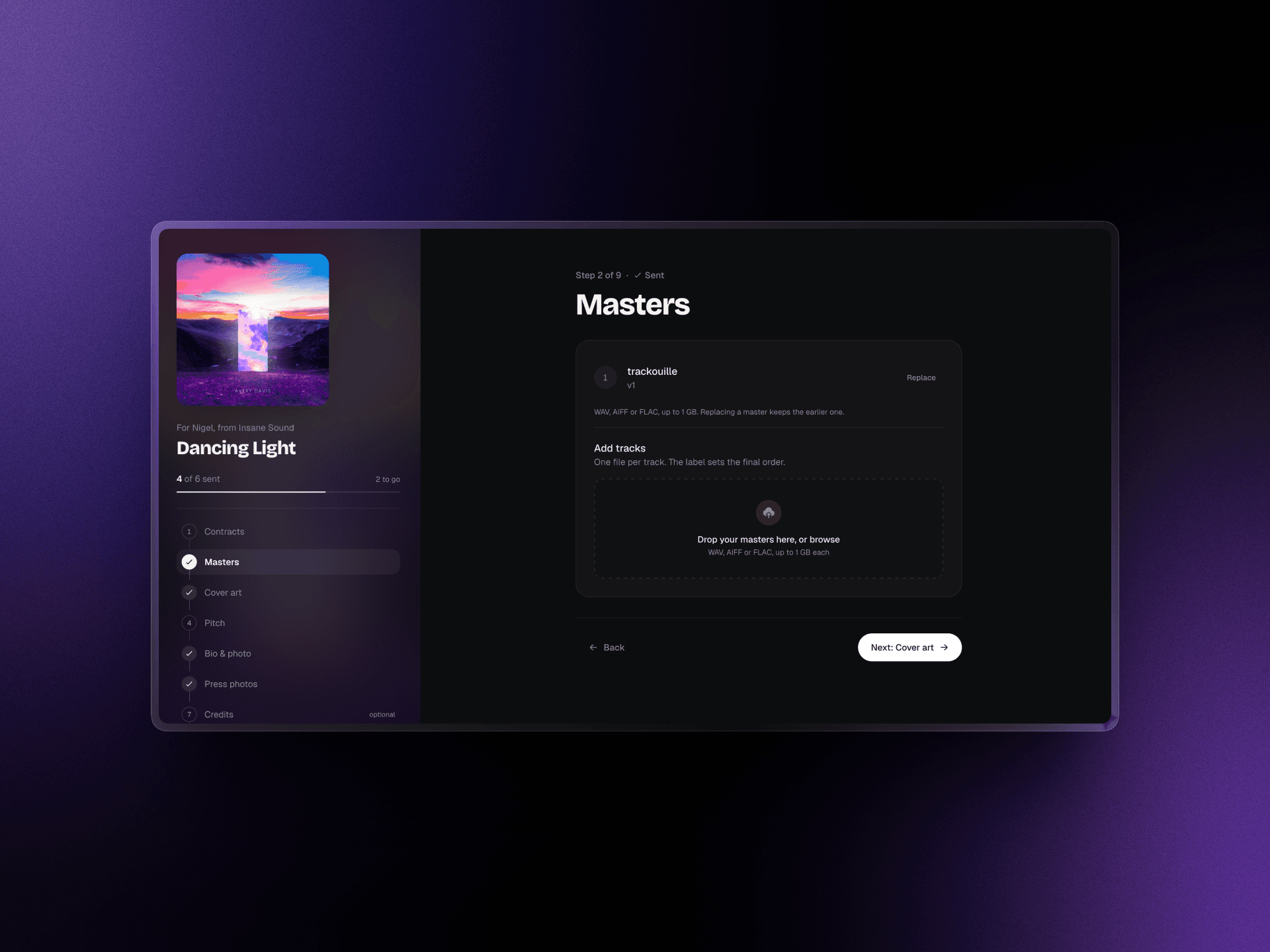
Participants upload masters and artwork, write the pitch and bio, declare their credits and send their legal details behind a one-time code.
The label keeps the last word
A second master arrives as a draft, covers as candidates, and a filled bio as a proposal. Reminders list only what's missing until everything is in.
“We replaced Notion, Airtable, and three Google Sheets with LabelBase. Our A&R team finally spends more time listening than managing spreadsheets.”
AntonioA&R, Head in the CloudsWhich tool slows your label down the most?
Tell us in a short call. We'll show you that part of LabelBase first, and how a label moves over one workflow at a time.
Built with independent labels
Labels on LabelBase process more than 2,000 demos and manage more than 100 releases on it every month, and over 1,000 releases have already shipped through the platform. Every feature started as a request from one of these labels, and improvements ship every week.
Multi-label workspaces let one team run several labels or sub-labels from the same account, and LabelBase is also on iOS. When you need help, you talk to the people who build the product, based in France.
“LabelBase is a must-have for your label: every useful tool gathered in one place.”
“LabelBase replaces multiple paid tools and eliminates the manual tracking that wastes our time.”
Record label software: your questions
What is record label software?
Record label software is a single workspace to run a label's work: A&R and demos, artist relationships, contracts, release planning, catalog and royalties. It replaces the mix of spreadsheets, chat servers and separate signature tools most independent labels start with, so everyone on the team works from the same data.
Is LabelBase a record label CRM?
Yes. LabelBase keeps every demo, artist and industry contact in one place: a submissions inbox for A&R, a network of contacts tagged by role, label or region, and a shared artist database. Unlike a generic CRM, it then follows those artists into contracts, releases and royalties.
Which tools can LabelBase replace?
Labels use LabelBase instead of a Discord server or inbox for demos, a Notion board or spreadsheet for releases, DocuSign for contracts, file transfers for collecting assets, and a spreadsheet to split royalties. You can move one workflow at a time.
How does LabelBase handle royalty statements?
You import the statement your distributor sends you and the AI reads it, then matches every line to a track in your catalog. Each artist's share is computed from the splits set on that track, amounts are converted at the rate you were actually paid, and every row is either counted, excluded or rejected with a reason.
Which distributors' statements can I import?
Any of them. LabelBase reads statements from Believe, DistroKid, The Orchard and Identity, as well as a sub-label's spreadsheet or your own CSV. The AI recognizes the columns, encoding and reporting period itself, so there is no template to configure for each distributor.
Are contracts signed in LabelBase legally binding?
Yes. Signatures collected in LabelBase are eIDAS-compliant electronic signatures, timestamped under RFC 3161, with an audit trail that records each step from the request to the signed document and its proof.
Do my artists have to pay to use LabelBase?
No. Artists don't need an account: they send masters, artwork, credits and details through the intake link of each release, and sign their contracts there, at no cost.
Can I run several labels or sub-labels?
Yes. Multi-label workspaces let one team run several labels or sub-labels from the same account. Each plan includes a number of labels, and you can add more for €8 per label per month.
Does LabelBase send my music to a third-party AI?
No. Audio analysis (genre, mood, BPM, key and instruments) runs on LabelBase's own private, self-hosted model, not on a third-party LLM, so your tracks are analysed without leaving LabelBase's infrastructure.
How much does record label software cost?
LabelBase plans start at €39 per month with Indie, then €99 with Team. Larger structures go on Industry, priced on the deal. Every plan comes with a 14-day free trial, no credit card required, and artists never pay to send their files.
Same label. Same team. One place instead of ten.
Without LabelBase
With LabelBase
Demos arrive on Discord, by email and through a form.
Every demo lands in one inbox the whole A&R team shares.
Contracts are retyped from a template, then sent through another tool.
Contracts come out pre-filled from the release and are signed in LabelBase.
The split sheet is a spreadsheet nobody quite trusts.
Splits set once on each track feed the contract and the royalties.
Royalties take days of copying five distributor reports.
Statements are read by AI and every share comes from your splits.
Your whole label, in one place
A short call with the people who build LabelBase: we look at how your label runs today and show you the workspace that replaces the stack. Every plan starts with a 14-day free trial.